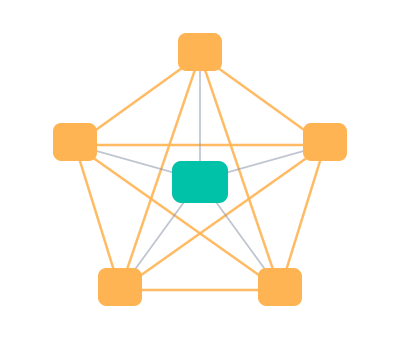
One framework,
several applications.
SIET is the commercial product. Everything on this page is the same structural mathematics applied to a different domain, and it is here because breadth is the reason to believe the method rather than a second thing to buy.
This page is in three parts: the products, the measured evidence behind the domains without a page of their own, and where the framework came from. The underlying thesis is set out on the framework page.
Part one
The domains
Two of these have a page of their own, with the full measured record and its limits. The rest carry their evidence in part two below.
Everything Engine
GlobalPlanetary Risk Intelligence
The world's first universal early warning system.
Overview
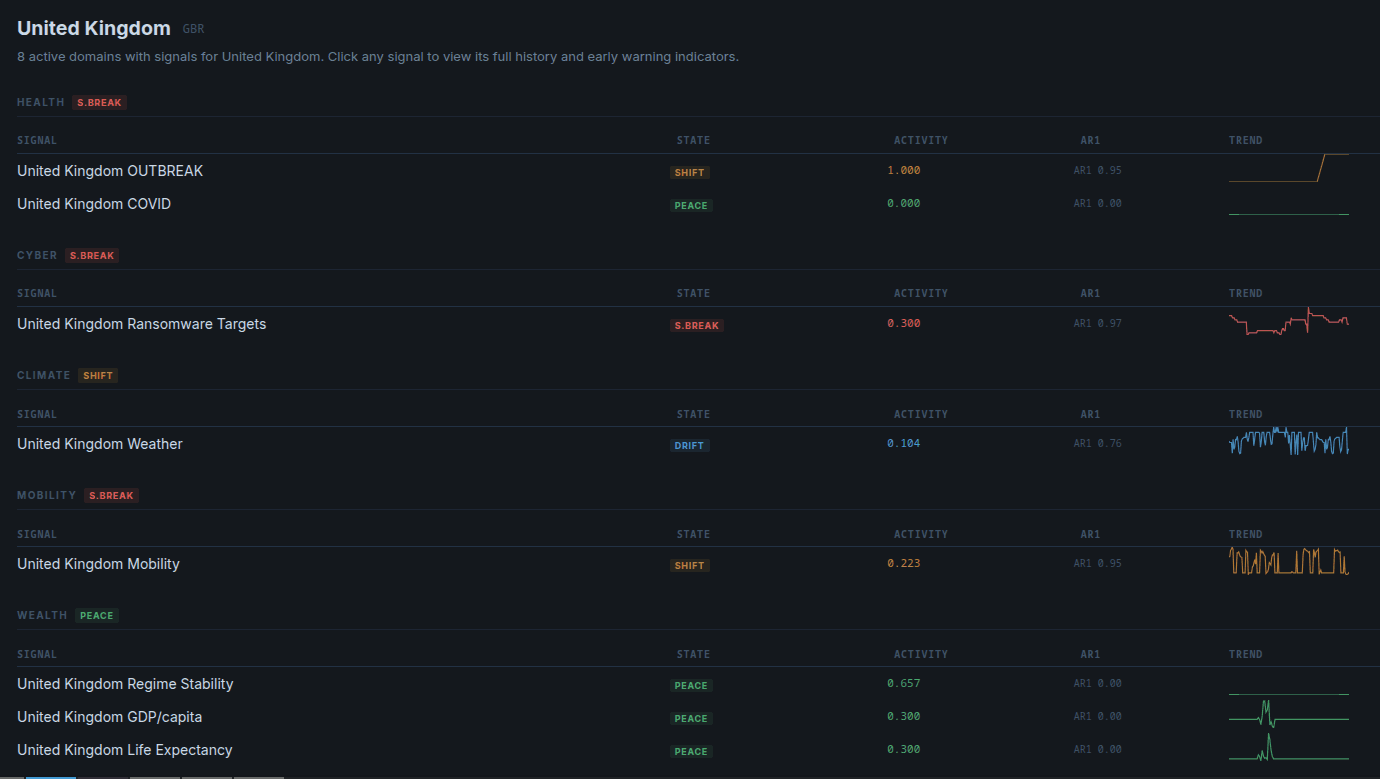
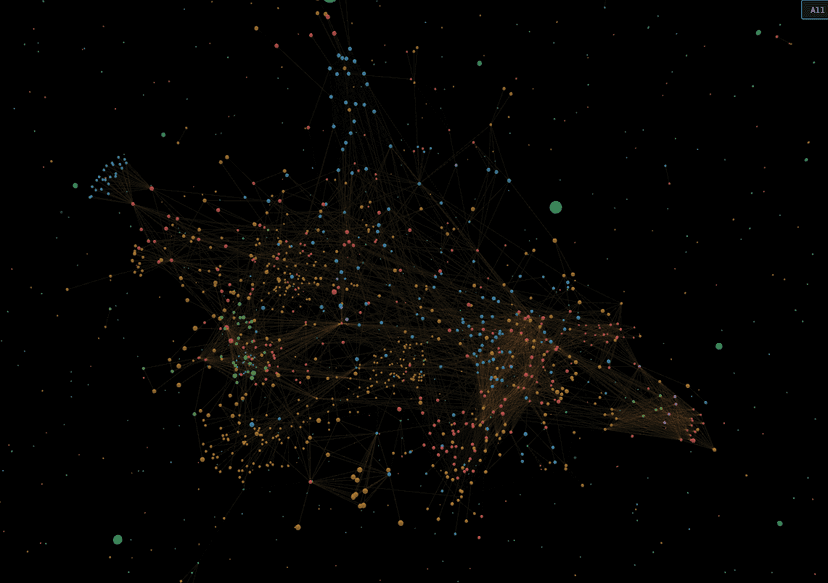
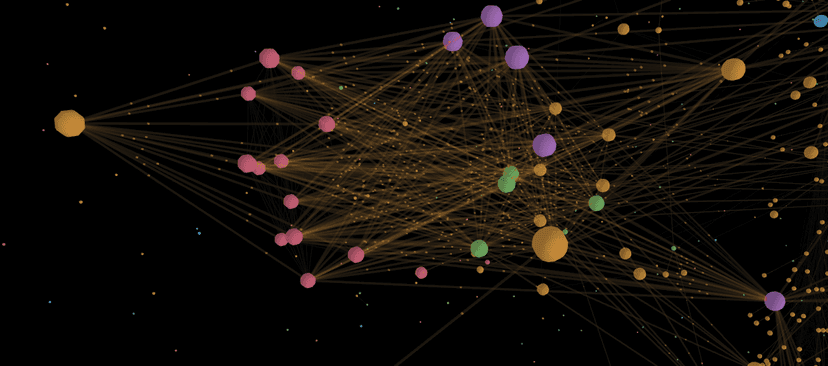
2,400+ nodes across 195 countries. 49,000+ edges. 21 live data sources spanning health, conflict, economics, energy, climate, food, displacement, marine, trade, and space.
The Everything Engine monitors the structural topology of global interdependence in real time. When the graph begins to show critical slowing down - elevated AR1, rising variance, compressing Fiedler eigenvalue - crisis is weeks away.
Replayed blind against 37 years of history: 21 of 25 catalogued events detected, most with 6-12 weeks of lead time. All four misses are documented, including one we chose not to recover because doing so would have cost roughly 14,000 false detections.
Capabilities
- ›Fiedler eigenvalue monitoring - algebraic connectivity as a fragility indicator
- ›Order Parameter (ORDER_P) - fraction of variance in a single principal component
- ›Scheffer AR1 + variance ratio - critical slowing down detection
- ›Crisis type classification: systemic rot vs external shock risk
- ›Cross-domain cascade and coupling detection
- ›Country-level and sector-level risk decomposition
Target Audience
Lloyd's syndicates, reinsurers, sovereign wealth funds, government agencies, UN bodies
Pricing
Institutional subscription tiers. Contact for terms.
Global Risk Detection ›Live system output
SI Platform + SIET
CybersecurityStructured Cyber Intelligence
Intrusion detection without rules. SIEM without signatures.
Overview
The Structured Intelligence Platform deploys edge sensors that build an in-memory graph of network connection topology. Anomalies are detected when graph metrics - not traffic content - deviate from baseline. Zero-knowledge by architecture.
SIET extends this to enterprise telemetry. It learns what each part of the estate normally does and raises a finding when something departs from its own history, not when a rule matches.
Measured on CICIDS2017 against a frozen benign baseline: every attack detected with no signatures and no attack knowledge, median time to detect under one minute, and 3 cases on a benign control day. Every attacked host was reported: 19 of 19, 18 as cases and 1 as a lower-tier observation. Port scan, DDoS, DoS, brute force, infiltration and C2 classes all caught.
Capabilities
- ›Detection by structural change, with no signature library to maintain
- ›Thresholds derived from each part of the estate's own history, not global constants
- ›Findings arrive pre-correlated as cases, not as an alert queue
- ›Metadata topology only - no payload inspection required
- ›Deterministic mathematics, so cost does not scale with event volume the way model inference does
- ›Multi-tenant MSSP architecture and Elasticsearch field normalisation across log sources
Target Audience
MSSPs, enterprise SOC teams, critical infrastructure operators
Pricing
Subscription tiers. Contact for enterprise pricing.
SIET ›Market SI
FinanceFinancial Structured Intelligence
See institutional accumulation before it moves price.
Overview
~700 UK and US equities monitored continuously. Every 15 seconds, a correlation graph is rebuilt and structural metrics computed. When the topology shifts - when density compresses, entropy falls, centrality concentrates - something is accumulating.
The same Scheffer indicators that detect a pandemic 11 weeks out detect the structural preconditions of a major equity move. The mathematics is the same. The domain is different.
Backtested to 67% win rate on ACCUMULATION structural breakout signals. Annualised Sharpe of 10.64 and Sortino of 46.62. Validated in paper trading before live deployment.
Capabilities
- ›Continuous correlation graph reconstruction across UK and US equities
- ›Three-layer regime framework: market connectivity, order parameter, Markov state
- ›ACCUMULATION, CONTAGION, and STRUCTURAL_BREAK signal classification
- ›Micro-scalp engine for LSE CHOPPY regime: 62% win rate
- ›AR1 autocorrelation and variance ratio for critical slowing down in markets
- ›Full backtested signal history with statistical validation
Target Audience
Systematic macro funds, algorithmic trading desks, quantitative allocators
Pricing
Signal subscription or AUM-based arrangement. Contact for terms.
Neural SI
AI / MLNeural Network Phase Intelligence
Predict what your model is about to do - 21,000 steps before it does it.
Overview
Neural networks undergo phase transitions during training - grokking, catastrophic forgetting, mode collapse. These are not random. They are structural. The weight graph Laplacian carries the signal weeks of training steps in advance.
Neural Structured Intelligence applies Scheffer early warning indicators to the spectral properties of the weight graph. AR1 and variance ratio computed on Laplacian eigenvalues. When these metrics indicate critical slowing down, a phase transition is imminent.
Validated across five sequential experiments: grokking detection with 21,000-step lead time, classification of forgetting vs grokking (3.7× faster λ₂ divergence), active steering with 91.7% knowledge retention, compounding across three tasks, and preemptive curriculum design.
Capabilities
- ›Weight graph Laplacian spectral analysis at training time
- ›Scheffer AR1 + variance ratio on λ₂ (algebraic connectivity)
- ›Phase transition classification: grokking vs catastrophic forgetting
- ›Active steering via targeted weight graph intervention
- ›Preemptive curriculum design from structural precursor signals
- ›Applicable to any architecture where weight topology is accessible
Target Audience
AI research labs, frontier model developers, organisations with large training compute budgets
Pricing
Research partnership and licensing. Contact for terms.
Everything Nuclear
EnergyFusion Plasma Structured Intelligence
Plasma disruption predicted before the disruption knows it is coming.
Overview
Fusion plasma is a dynamic system. Disruptions - sudden, catastrophic losses of confinement - are the primary engineering risk in tokamak operation. On ITER, a single disruption could damage the first wall.
Using the FAIR-MAST public dataset from UKAEA's MAST tokamak, we applied the Structured Intelligence framework to multi-channel plasma diagnostic time series. Disrupted plasmas exhibit sustained elevated Fiedler eigenvalue throughout flat-top - a structural predisposition detectable from the start of the shot, not just in the precursor phase.
F1=0.714. Recall=1.000. Mean lead time: 49% of flat-top remaining (~153ms absolute). On ITER geometry, this would provide approximately 5× the required 30ms response window.
Capabilities
- ›Multi-channel plasma diagnostic graph construction
- ›Fiedler eigenvalue trajectory monitoring across flat-top
- ›Disruption vs stable confinement classification
- ›Early structural predisposition detection - not just precursor detection
- ›Confinement quality correlation: eigenvector centrality vs H₉₈ (r=0.405)
- ›Applicable to any tokamak with multi-channel diagnostic output
Target Audience
UKAEA, EUROfusion, Commonwealth Fusion Systems, ITER Organisation, fusion research groups
Pricing
Collaboration and grant-funded research. Contact for terms.
Part two
The evidence record
Measured results for the three domains without a page of their own. Global risk and cyber carry their full records, including known limitations, on Global Risk Detection and SIET.
Financial signal validation
Backtested and paper-traded on ~700 UK and US equities. Win rates and returns measured before live capital deployment.
ACCUMULATION structural breakout
LSE CHOPPY micro-scalp
CONTAGION structural breakout
AI phase transition results
Five sequential experiments validating the application of Scheffer early warning indicators to neural network weight graph Laplacian spectral properties.
Grokking detection
21,000-step lead timeAR1/variance ratio on λ₂ detects grokking precursor 21,000 steps before the phase transition occurs.
Forgetting vs grokking classification
λ₂ rate 3.7× fasterAlgebraic connectivity diverges at different rates for catastrophic forgetting vs grokking - classifiable from spectral trajectory.
Active steering
91.7% knowledge retainedTargeted intervention on weight graph topology at detected precursor. Unsteered baseline: 2.6% retention.
Compounding (3 tasks)
100% / 100% / 97.5%Compounding steering across three sequential tasks with 48× training acceleration.
Preemptive curriculum
100% vs 0% baselineStructural signal used to design training curriculum before forgetting begins. Unsteered baseline: 0% preservation.
Plasma disruption results
Applied to the FAIR-MAST public dataset (UKAEA). Preliminary computational results, not peer-reviewed. Collaboration with fusion research institutions welcome.
Disrupted plasmas exhibit sustained elevated Fiedler eigenvalues (3 to 4) throughout flat-top, a structural predisposition detectable from the start of the shot rather than only in the final precursor window. On ITER geometry, the ~153ms absolute lead time provides roughly 5× the required 30ms disruption mitigation response window.
Part three
Where this came from
It started with a network sensor.
In October 2025, work began on a network intrusion detection system with an unusual constraint: no signatures, no rules, no content inspection. The only input was the topology of connections, who talked to whom, and how the shape of that conversation changed over time.
The sensor worked. Anomalies were detectable purely from graph structure: density collapsing, entropy spiking, centrality concentrating in nodes that should not be central. The network was telling a story before any alert fired.
The question became: what else tells this story?
Over the following eight months, the same metrics were applied to equity correlation graphs, threat actor relationship networks, global interdependence data, neural network weight matrices, and plasma diagnostic time series. Every domain yielded the same result: structural change precedes observable crisis.
This is not a coincidence. It is a property of complex systems under stress.
What the mathematics says.
Fiedler eigenvalue (λ₂)
Algebraic connectivity of the graph. As a system approaches a tipping point, the second-smallest Laplacian eigenvalue compresses. The network loses its ability to propagate perturbations and becomes brittle.
Order Parameter (ORDER_P)
Fraction of total variance explained by the first principal component. When this rises sharply, the system is synchronising: diverse, independent dynamics are collapsing into a single mode. Classic precritical behaviour.
AR1 (Autocorrelation at lag 1)
From Scheffer's critical slowing down theory. As a system approaches a bifurcation, recovery from perturbations slows and AR1 approaches 1. A reliable cross-domain early warning signal.
Variance ratio
Complementary to AR1. Variance of the time series inflates as the system loses resilience. Combined with AR1, this provides two independent lines of evidence for an approaching transition.
Eight months. Six domains. Company registered.
Network intrusion detection
First application of graph topology metrics to network connection data. Zero-knowledge detection without rules or signatures. The Structured Intelligence Platform is born.
Financial markets
The same metrics - density, entropy, centrality, velocity - applied to equity correlation graphs. 67% win rate on institutional accumulation signals. The framework is not domain-specific.
Cyber threat intelligence
Threat actor relationship graphs monitored via structural topology. PocketSIEM and SIET deployed for MSSP threat intelligence at scale.
Planetary risk
The Everything Engine: 16 global domains, 195 countries, 49,000+ edges. Scheffer early warning indicators applied to the world-as-graph. 21 of 25 catalogued crises re-detected blind across 37 years, most with 6-12 weeks of lead time.
Neural networks
Weight graph Laplacian spectral analysis. AR1 and variance ratio on λ₂ detect grokking 21,000 steps before it happens. 91.7% knowledge retention under active steering. Patent filed: GB2611542.8.
Fusion energy
FAIR-MAST plasma diagnostic data. 100% recall on disruption detection. Fiedler eigenvalue trajectory detectable from the first seconds of a tokamak shot. Structural predisposition - not just precursor.
Company registered
Structured Intelligence Ltd registered in England and Wales (Company No. 17272061), with SIET as the commercial product.
How we work.
One law, many domains
The framework is not a collection of domain models. It is a single observation: systems approaching critical transitions exhibit structural changes in their relational topology that precede the transition itself. This is invariant across physical, economic, biological, and computational systems.
Show the misses
Four of 25 catalogued crises were not detected, and all four are named on the Global Risk page with the reason each failed. One of them we chose not to recover, because doing so would have cost roughly 14,000 false detections to reinstate a single marginal hit. Credibility is built on honesty about limits, not on curated success stories.
Validate before you claim
Every metric, every win rate, every lead time on this website is backed by data. Market signals were paper-traded before live capital. Neural experiments were run sequentially, each building on the last. No retrospective curve fitting.
Privacy by architecture
The cyber products process graph topology, not content. No traffic data leaves the sensor. No user data is required. Zero-knowledge is not a compliance checkbox - it is how the mathematics works.
Looking for the product?
SIET is what we sell. Everything on this page is the same maths pointed at a different problem, and it is here because it is the reason SIET works.