Crises have a shape
before they have a name.
Before a pandemic is declared, before a currency breaks, before a conflict escalates, the relationships between global systems start to deform. That deformation is measurable, and it is measurable weeks in advance.
The Everything Engine monitors the structure of global interdependence continuously across 195 countries. It does not forecast from precedent and it does not wait for an indicator to move. It watches the shape of the system and reports when the shape breaks.
Replayed against 37 years of historical data the system had never seen, with no event calendar consulted during detection. Every signal below was flagged blind, in the event's own country, before the event.
Everyone is watching the outputs.
Global risk monitoring is built around indicators, and indicators are consequences. They tell you a crisis is underway, which is the one thing you already knew.
Watching indicators means waiting for the damage
Case counts, casualty figures, price moves and displacement totals are all measurements of a crisis that has already started. By the time an indicator is unambiguous, the window in which intervention was cheap has closed.
Forecasting models need the event to have happened before
A model trained on past pandemics predicts pandemics. It has nothing to say about the crisis that does not resemble its training set, which is reliably the one that matters. Every novel event is out of distribution by definition.
Analysts are organised by region and domain
The structure that carries a crisis does not respect those boundaries. Conflict pushes displacement, which stresses food systems, which moves commodity prices. Split across desks, the coupling is exactly what nobody owns.
Expert judgement does not scale to 195 countries
Continuous, even attention across every country and every domain is not achievable by staffing. Coverage concentrates where attention already is, so the surprises arrive from wherever nobody was looking.
Watch the connections, not the readings.
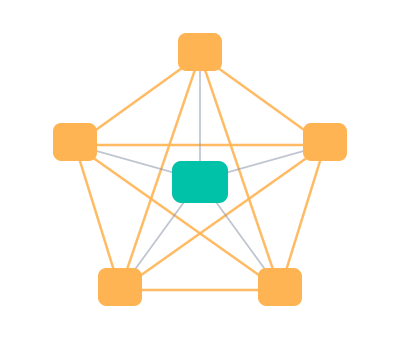
Global systems are coupled. Conflict pushes displacement. Displacement stresses food and health systems. Food prices move commodity markets. Those couplings are not declared by us and not taken from a textbook: they are measured from how the signals actually move together, and they change as the world changes.
A stable system absorbs shocks. A fragile one stops absorbing them, and the loss of that capacity shows up in the structure of the network before it shows up in any single reading.
So the engine does not ask whether a number is high. It asks whether the relationships around that number are behaving the way they normally do, and it reports the moment they stop.
Nobody tells it what a crisis looks like. That is the point: a system that has to recognise the crisis cannot see a new one.
What this produces
- ›Early warning with the country and the domain attached, not a global risk index.
- ›Coverage that does not depend on where analyst attention happens to be pointed.
- ›Cross-domain cascade detection: which system is stressed, and what it is likely to burn through next.
- ›Novel and unprecedented events handled on the same footing as familiar ones.
- ›Deterministic mathematics over live feeds. No model inference and no training set to go stale.
The detection mathematics is proprietary and is not described here. Technical detail is available to qualified partners under NDA.
Live system output
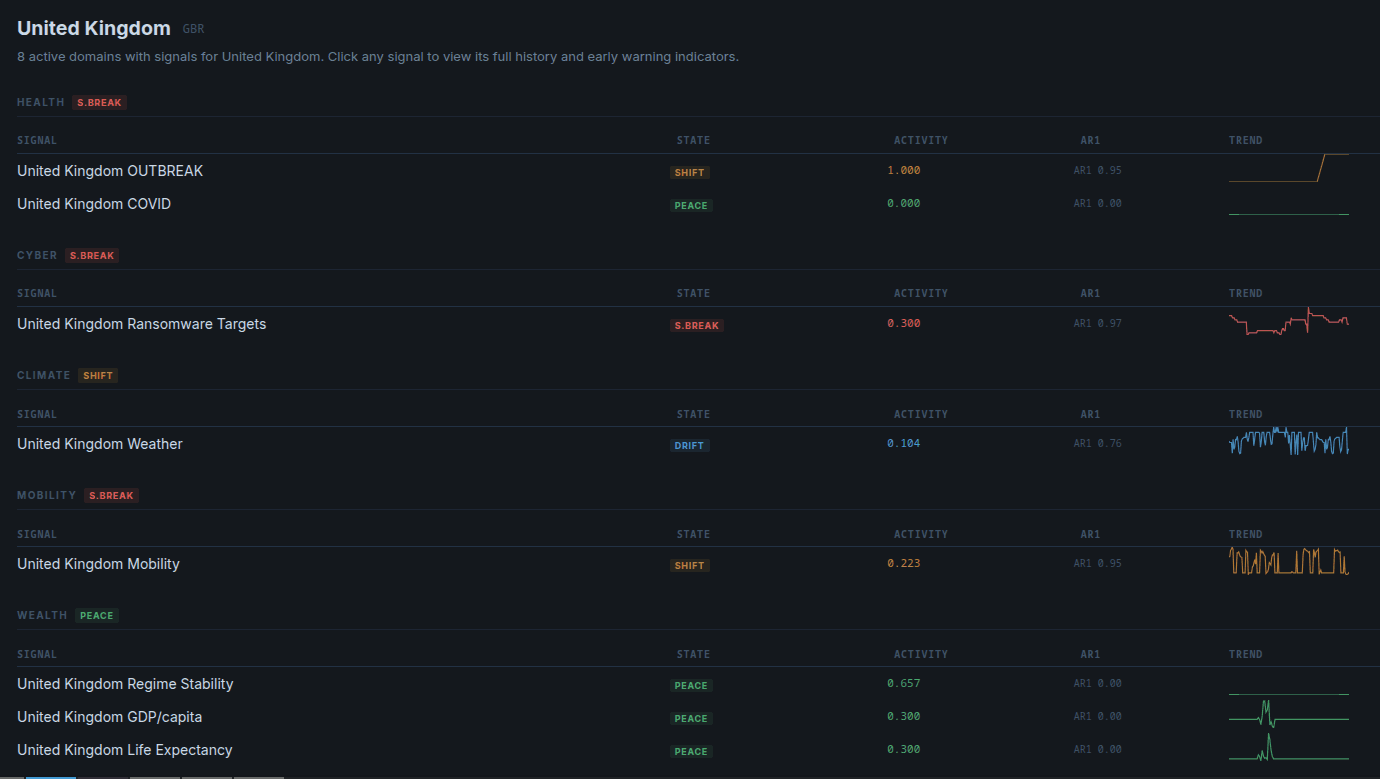
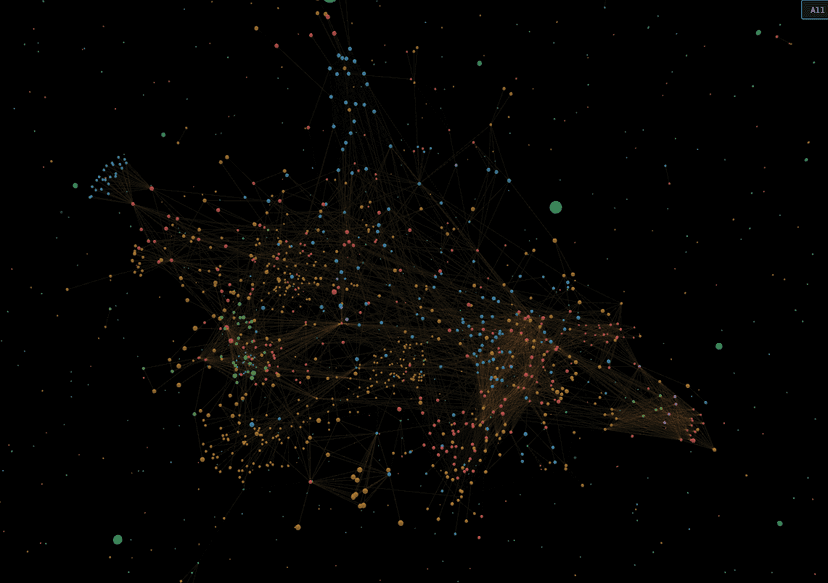
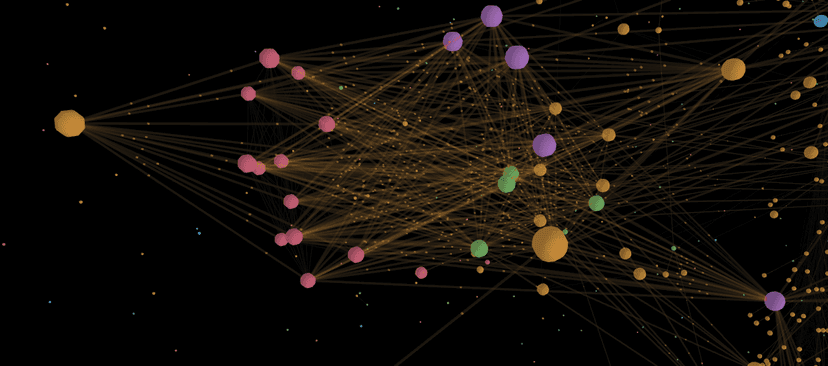
Twenty-one crises, detected blind, across thirty-seven years.
The system was replayed against data from 1989 to 2026 that it had never seen, with no knowledge of which events were coming. A detection counts only when a signal escalates in a credible domain, in the event's own country, inside a twelve-week window before the event. The signals below are the ones it actually fired on.
| Event | Year | Lead time | Signal that fired |
|---|---|---|---|
| Global Financial Crisis | 2008 | 11.1 weeks | Shipping freight structural break |
| H1N1 Swine Flu | 2009 | 11.6 weeks | Mexico health surveillance |
| Arab Spring: Tunisia | 2011 | 2.7 weeks | Tunisia political unrest |
| Fukushima | 2011 | 10.7 weeks | Japan climate and weather |
| East Africa Famine | 2011 | 0.4 weeks | Kenya health (concurrent) |
| Annexation of Crimea | 2014 | 10.6 weeks | Russia political unrest |
| European Refugee Crisis | 2015 | 6.3 weeks | Turkey conflict events |
| Brexit Referendum | 2016 | 10.6 weeks | UK political unrest |
| Rohingya Crisis | 2017 | 9.7 weeks | Myanmar conflict events |
| Yemen Famine | 2017 | 2.4 weeks | Yemen climate and weather |
| COVID-19 Pandemic | 2020 | 10.4 weeks | Italy health surveillance |
| Tigray Conflict | 2020 | 9.4 weeks | Ethiopia political unrest |
| Myanmar Military Coup | 2021 | 10.1 weeks | Myanmar political unrest |
| Suez Canal Blockage | 2021 | 11.3 weeks | S&P 500 structural break |
| Invasion of Ukraine | 2022 | 9.6 weeks | Ukraine conflict events |
| Pakistan Floods | 2022 | 9.1 weeks | Pakistan climate and weather |
| Turkey/Syria Earthquake | 2023 | 5.1 weeks | Turkey climate and weather |
| Sudan Civil War | 2023 | 8.9 weeks | Sudan conflict events |
| Gaza War | 2023 | 11.9 weeks | Palestine political unrest |
| Iran-Israel Exchanges | 2024 | 11.9 weeks | Israel stock-index stress |
| Global Financial Stress | 2025 | 11.3 weeks | S&P 500 structural break |
Two entries are worth reading carefully rather than counted as wins. East Africa Famine 2011 fired at 0.4 weeks, which is concurrent rather than early, and Arab Spring Tunisia at 2.7 weeks is short. Both are in the ledger as detections because they met the rule, and both are weaker than the roughly ten-week cases around them.
Selected detections in detail
What the signal was, what it meant, and what followed.
Expand ›Collapse ‹
Selected detections in detail
What the signal was, what it meant, and what followed.
Global Financial Crisis
Shipping / TradeGlobal shipping freight was the node that broke first. Structural stress in trade and shipping coupling registered ahead of the September 2008 collapse, in a domain most financial monitoring was not watching.
Worst financial crisis since 1929. $20T+ in global wealth destruction.
H1N1 Swine Flu Pandemic
HealthMexico health surveillance broke structurally ahead of the WHO pandemic declaration, in the country where the outbreak originated.
First influenza pandemic of the 21st century.
Arab Spring - Tunisia
PoliticalTunisia political unrest broke structurally ahead of Ben Ali fleeing the country. The equivalent signals for Egypt and Syria crossed threshold at or just after their tipping points and are counted as misses.
Regime change in Tunisia. Region-wide uprising followed.
* Short lead. Fast political escalations sit near the limit of a weekly detection cadence.
Russian Annexation of Crimea
PoliticalRussia political unrest registered one of the strongest deviations in the entire record, more than ten weeks before the annexation.
First forcible annexation of European territory since WWII.
European Refugee Crisis
Conflict / DisplacementTurkey conflict events broke structurally ahead of the mass movement into Europe, on the transit route rather than at the destination.
1.3M asylum applications in 2015. Largest refugee crisis since WWII.
Rohingya Crisis
ConflictMyanmar conflict events produced the largest single deviation in the record, more than two months before military operations began.
700,000+ displaced. ICJ genocide proceedings.
COVID-19 Pandemic
HealthItaly health surveillance broke structurally more than ten weeks before the WHO pandemic declaration, identifying the country that became the first European epicentre.
Largest global health and economic disruption in a century.
Tigray Conflict
PoliticalEthiopia political unrest broke structurally more than two months ahead of the outbreak of hostilities.
500,000+ deaths estimated. Largest humanitarian crisis of the 2020s.
Suez Canal Blockage
MarketsS&P 500 structural stress registered ahead of the Ever Given grounding and the trade disruption that followed.
$9.6B/day in delayed trade. Global supply chain disruption.
Russian Invasion of Ukraine
ConflictUkraine conflict events broke structurally more than two months before the February 2022 invasion.
Largest land war in Europe since WWII.
Sudan Civil War
ConflictSudan conflict events broke structurally ahead of the April 2023 outbreak of fighting between the SAF and RSF.
Largest displacement crisis in the world by 2024.
Gaza War
PoliticalPalestine political unrest broke structurally almost twelve weeks before 7 October 2023.
Ongoing regional conflict and humanitarian crisis.
Iran-Israel Exchanges
EconomicIsrael stock-index stress carried the signal. This event was recovered only after annual economic indicators were replaced with daily national stock-index data, which is documented as a change to the detector.
First direct Iran-Israel military exchanges.
Global Financial Stress
MarketsS&P 500 structural break registered ahead of the April 2025 dislocation.
Ongoing.
Non-events: stress that did not cascade
The following situations showed elevated structural stress that did not cascade into a full systemic crisis, and were assessed as contained or recovering rather than escalated. These are the cases a detector tuned for recall would have called wrongly.
- ›US-China trade war escalation (2019) - detected elevated tension but no structural break; no crisis materialised
- ›Brexit transition (2020) - elevated UK sub-graph fragility; contained, no systemic cascade
- ›Evergrande default (2021) - Chinese real estate stress detected; contained by intervention
- ›COVID Omicron wave (2021) - health graph elevated; no mortality-scale crisis materialised
- ›SVB / Credit Suisse (2023) - financial stress detected; systemic contagion contained
- ›Middle East conflict escalation (2024) - regional stress; no global cascade
The four misses
A recall figure quoted without its failures is marketing. Here are ours, with the reason each one failed.
Arab Spring: Egypt and Syria
Fast escalations. On a weekly cadence the signal crosses threshold at or just after the tipping point rather than before it, despite pre-tip deviation running high. A resolution limit, not a data gap.
West Africa Ebola, 2014
The only regression against our earlier method, and we chose to keep it. Recovering it would have meant lowering a threshold in a way that produced roughly 14,000 additional false detections to reinstate one marginal hit. We took precision over recall and documented the miss.
Beirut Port Explosion, 2020
A single-day industrial accident with no measurable structural precursor in any domain. Arguably unpredictable by any method.
Against conventional risk monitoring.
| Indicator and forecast monitoring | Structural detection | |
|---|---|---|
| Question asked | Has something bad happened? | Are the structural relationships changing in a way that means something is about to? |
| Novel events | Out of distribution. The model has no precedent to match | Detected on the same basis as any other. Novelty is not a special case |
| Coverage | Concentrated where analyst attention already is | Even across 195 countries and 16 domains, continuously |
| Cross-domain effects | Split across regional and thematic desks | Measured directly. Coupling between domains is the primary signal |
| Output | A situation report describing current conditions | Which country, which domain, and how far ahead of the event |
| Basis | Trained on catalogued history, or on expert priors | Deterministic mathematics over live data. No event calendar consulted |
We are not claiming this replaces regional expertise or domain analysis. It tells you where and when to point them, several weeks earlier than the indicators would, and it covers the ground nobody is currently watching.
What this record does not establish.
Early warning is a field with a long history of overclaiming. We would rather you discount us for the limits we publish than for the ones you find later.
Our internal validation record documents each threshold decision and the false-detection cost of the alternatives we rejected, including the one case where recovering a missed event would have cost roughly 14,000 spurious detections. That record is available to partners under NDA.
Where weeks of warning change the decision.
Reinsurers and Lloyd's syndicates
Pre-crisis structural signal for parametric trigger design, sovereign exposure monitoring, and portfolio-level early warning across territories you write.
Government, defence and security
Geopolitical early warning with even coverage across all 195 countries, including the ones with no desk assigned to them.
Humanitarian and multilateral bodies
Food insecurity, displacement and health signals weeks ahead of the declarations that release funding, when pre-positioning is still possible.
Sovereign funds and macro allocators
Structural stress in the coupling between economies, markets, energy and shipping, on a horizon that is actionable rather than reactive.
Ask us about the events we missed.
We will walk you through the full 37-year ledger, the detection rules, the four failures and why we chose to keep one of them. Then we will show you what the engine is flagging this week. Technical detail is available under NDA.
Request a BriefingWe respond within 48 hours. All enquiries are treated as confidential.